Anodising
SURFACE FINISHES: ANODISING
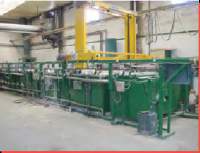
To protect itself from the weather, aluminium naturally forms a thin oxide film (Al2O3), which can reach 0.2 to 0.4 µm on metal that has been in an annealing furnace. The chemical treatments found in an anodising line are as follows:
Degreasing: the first stage of the process, essential to obtain a clean surface well prepared for the following stages. Cleaning is carried out with acidic detergents and emulsifiers.
Satin etching: this process produces a fine matt finish by creating a controlled surface roughness. It is achieved in sodium hydroxide solutions with aluminium-stabilising additives for correct dissolution.
Electrolytic colouring: deposition of metal ions by an electrolytic process with alternating current. Only electrolytic colouring offers the same outdoor resistance guarantees as natural anodising.
The light-fastness rating according to ISO 2135:2010 is 10.
Recommended anodic coating thickness
- For indoor and mild environments, a coating of 5 to 7 µm is sufficient.
- For outdoor and harsh environments, the coating should be at least 15 µm thick.
- For marine and extreme environments, an anodic coating of about 20 µm is recommended.
Finishes
 Matt silver PLM1 |  Matt stainless INM1 |  Matt bronze BRM1 |  Matt bronze BRM2 |
Tell us about your project and our technical department will advise you. Contact us.